
Consulting
AI strategy consulting
Most companies have already run at least one AI pilot. A minority have taken even one pilot to stable, ongoing use. The gap usually is not the model, it is whether the process had a measurable payoff and whether the real running cost was worked out before starting. We help pick the right entry point so budget does not disappear into a demo that stays a demo.
- Pricing
- From $820 · ≈ 60,000 ₽
- Timeline
- The audit and strategy take 1 to 2 weeks. The pilot itself, if you decide to build it, is scoped separately and typically takes 4 to 6 weeks.
A starting price. The total depends on scope, integrations and deadlines.
In short
AI strategy consulting starts at ₽800 and takes 1 to 2 weeks: an audit of processes for AI suitability, an ROI calculation for each candidate, selection of the pilot process, architecture recommendations (RAG, an off-the-shelf model, an agent), and a 3 to 6 month rollout plan with success metrics agreed in advance. Industry estimates suggest 60 to 70 percent of companies have already run at least one generative AI pilot, but only 25 to 30 percent have taken it to stable production use, and the point of a strategy is landing in that second group.
Why pilots stall before production
The most common reason is that the process got picked for being interesting rather than for its payoff: "let’s try a chatbot" sounds more appealing than "let’s automate triage for repetitive requests," even though the second one almost always pays back faster. The second reason is that nobody worked out the running cost in advance: a pilot handling 20 requests a day costs pennies, and the same pilot at 20,000 requests a day through an external API becomes a real budget line that people discover after the fact.
The third reason is no owner for the outcome. A pilot that "IT in general" is responsible for has nobody accountable for it actually saving money or hours, and it quietly dies after the internal demo-day presentation. A pilot that succeeds always has one named person accountable for a specific metric.
How we pick where to start
A good first candidate is a repeating, high-volume operation with tolerance for error and existing data behind it: triaging inbound requests, extracting fields from documents, searching an internal knowledge base, drafting routine replies. Practice from 2025 and 2026 shows the fastest payoffs tend to land in back-office and customer support, where there is a lot of repetitive text-based work, not because it is the most impressive use case, but because it is measurable and low-risk.
We score each candidate along four axes: revenue growth, cost reduction, faster cycle time, reduced risk and errors. A candidate that wins on two axes at once is usually the right entry point. We check the data separately too: does it exist, what state is it in, and would the task actually need six months of labelling first. If so, we say plainly that the task is not ready yet.
Architecture and the real running cost
The strategy includes a baseline architecture recommendation: most text tasks need only retrieval over your own data combined with a language model (RAG), with no need to fine-tune a custom model, which is faster and cheaper. For classification tasks, an off-the-shelf model with no generative AI at all is often enough. For sensitive data (personal data, trade secrets), we look at models deployed on your own infrastructure, with data localisation requirements in mind.
Running cost gets its own line, separate from build cost: for solutions built on external models, the main expense is not the initial setup but the monthly request volume, and it grows with usage. We cost this line at realistic volume, not demo-level load, so the investment decision gets made with the full picture.
What the work includes
- An audit of 5 to 10 automation candidates scored across four impact axes
- An ROI calculation for each candidate at realistic usage volume
- A recommended pilot process with rationale and a named outcome owner
- An architecture recommendation: off-the-shelf model, RAG, or fine-tuning
- A running-cost estimate at realistic request volume
- A data check: what exists, its condition, and what still needs labelling
- A 3 to 6 month rollout plan with success metrics agreed in advance
- A risk review: data protection law, data localisation, external provider dependency
How we work
- 01
Process audit
We list repeating operations and score each by volume, data availability and error tolerance.
- 02
ROI calculation
We calculate payoff and running cost for each candidate at realistic volume.
- 03
Pilot and architecture choice
We pick the process with the best payoff-to-risk ratio and recommend an architecture.
- 04
Rollout plan
We assemble a 3 to 6 month plan with success metrics agreed before the pilot starts.
- 05
Handover
We hand over the document and walk through it on a call; from there we can continue into building the pilot.
Technology and tools
- Python
- LangChain
- PostgreSQL / pgvector
- Notion
- Miro
- GigaChat
- YandexGPT
Selected work
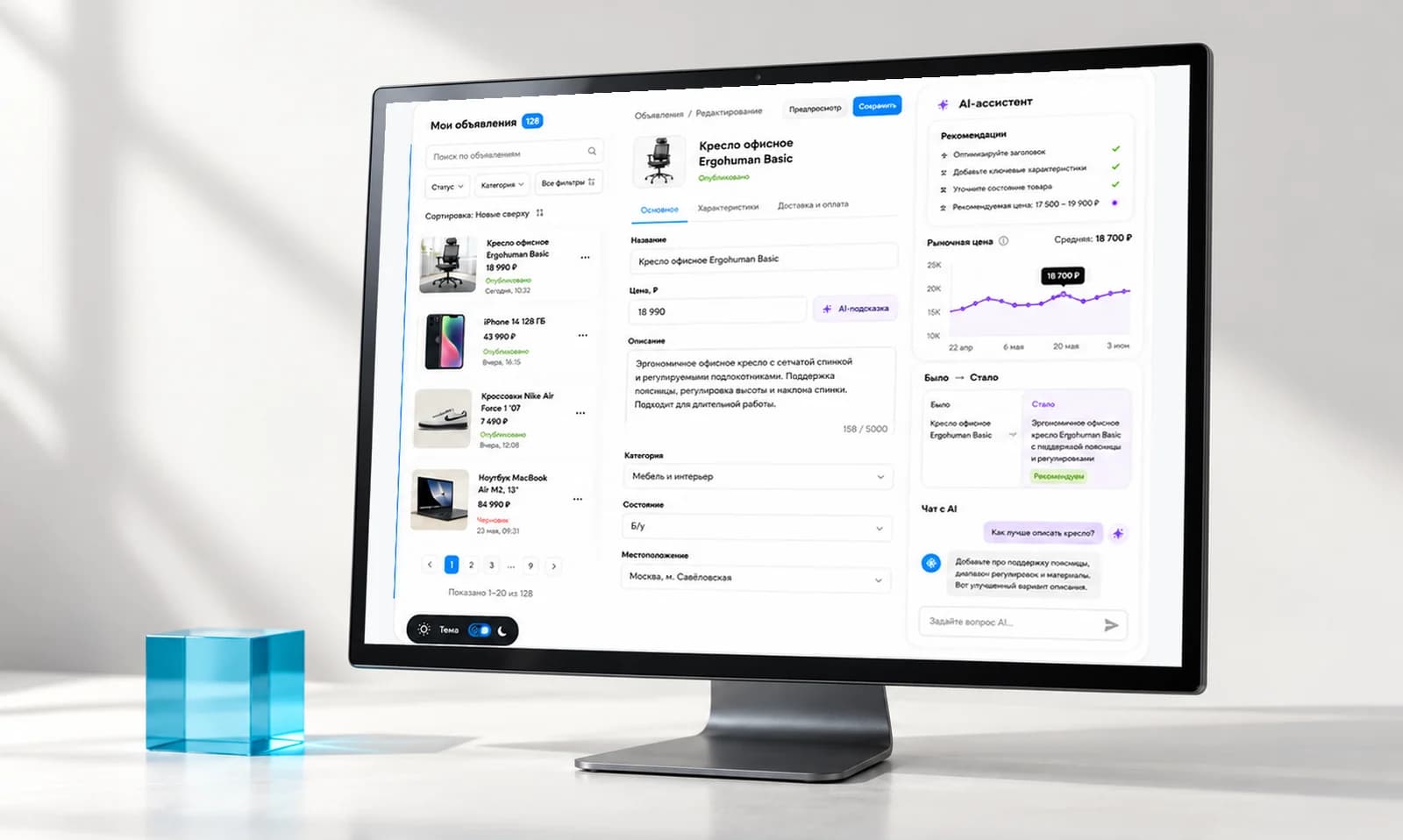
AI Assistant for Listing Optimization
A tool for Avito sellers that helps create and improve product listings faster.
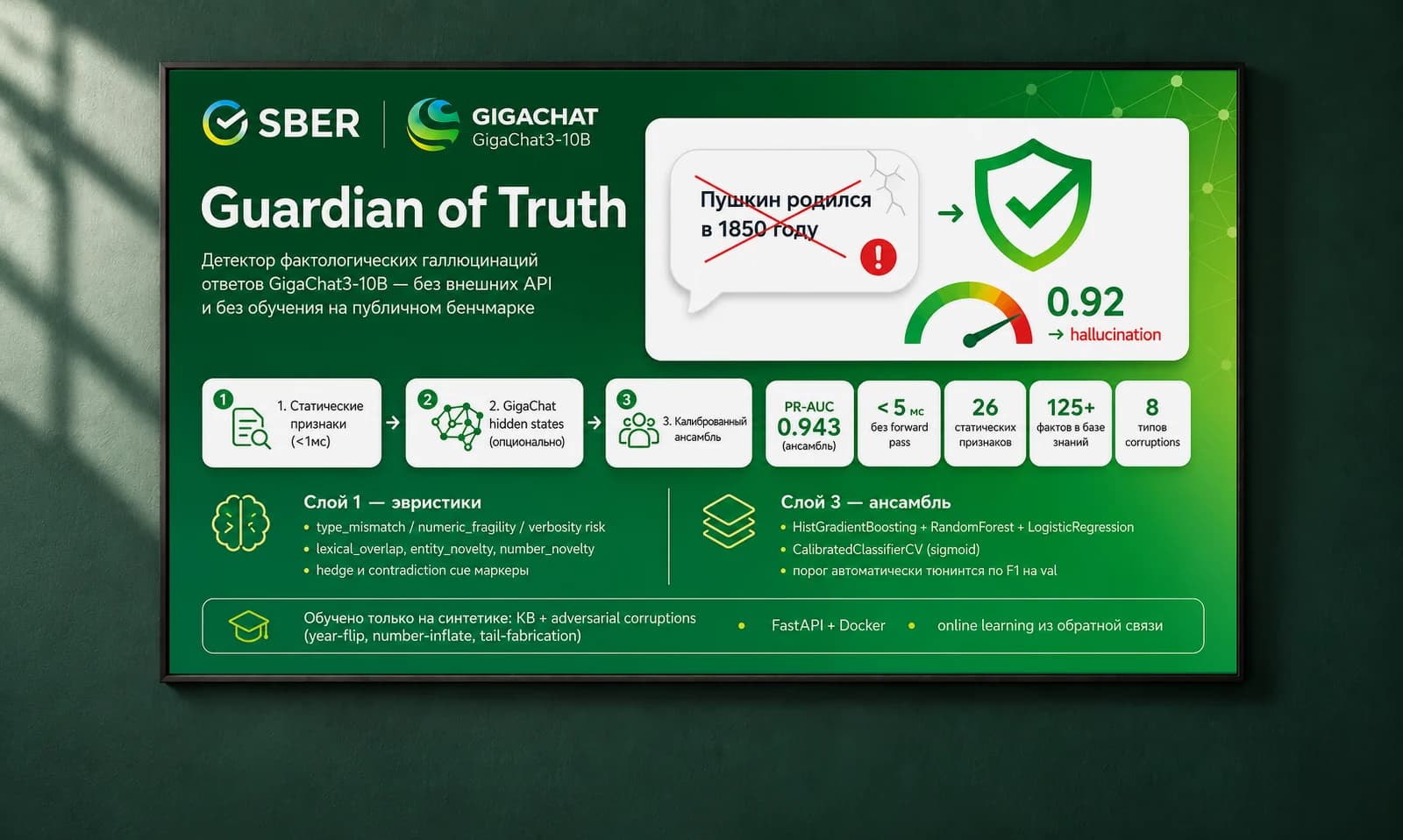
Sber — Guardian of Truth
Checks GigaChat answers for factual hallucinations and returns a probability of invented facts — no external APIs or fine-tuning.

MOEX Alpha Autopilot
An autonomous MOEX trading system: analyses the market, validates ideas and places trades on the live exchange with strict risk controls.
Frequently asked questions
How much does AI strategy consulting cost?
From ₽800 for a process audit, an ROI calculation across 5 to 10 candidates, and a 3 to 6 month rollout plan, delivered in 1 to 2 weeks. This is a separate service from building the pilot itself; if you decide to build it, that is scoped by task volume once the strategy has defined what to build.
Why do so many AI pilots never reach production?
Industry estimates put it at 60 to 70 percent of companies having run at least one generative AI pilot, but only 25 to 30 percent reaching stable production use. The reason is rarely the technology: the process got chosen for being interesting rather than for a measurable payoff, running cost at real volume was never worked out in advance, and the pilot had no owner accountable for a specific metric. A strategy exists to close all three gaps before the start, not after.
Where do we start with zero prior AI experience?
With an audit, not with a technology. We look at your processes and find a high-volume repeating operation with existing data behind it, usually request triage, document handling, or internal search. The first pilot is chosen for measurable payoff and low risk, not for being interesting to try. The team’s AI experience builds naturally along the way; there is no need to start with a full in-house AI team.
How is this different from AI/ML development?
This service answers "what to build and why"; AI/ML development answers "how to build it." Strategy consulting produces an audit, an ROI calculation, an architecture choice and a plan, all in one document. From there you can build the pilot with us through the separate development service, or hand the document to your own team. Strategy consulting does not commit you to ordering the build from us.
Do you guarantee the pilot will pay off?
No, and anyone guaranteeing that at the strategy stage is overselling it. We give an honest estimate of expected impact based on process volume and typical automation rates for comparable tasks, and we show the running cost transparently. If the calculated payoff looks small or uncertain, we say so directly and either propose a different candidate or acknowledge the task is not ready for automation yet.
Want to talk it through?
Tell us what needs building. We will work through the task, propose an approach and send a staged estimate. No charge, no commitment.
Related services
- AI and ML developmentWe build AI that solves a defined task and pays for itself, not demos for the sake of demos. Classifiers, recommendations, text and document processing, LLM assistants, and model integration into an existing product.
- IT consulting and product auditThe most expensive mistakes in software happen before the first line of code: a misread problem, a stack chosen out of a contractor’s habit, and a specification that does not exist. Consulting exists to settle all of that before the development meter starts running: what to build, out of what, at what cost and in which order. The result is a document, not an opinion on a call.
- Web app and Telegram Mini App developmentFor when a site is no longer enough and you need a product: an account area, a dashboard, an internal tool or a Mini App inside Telegram. We design the architecture, write the backend and frontend, and take it to release.
Terms used on this page
Further reading
- Why AI Pilots Never Reach Production: A BreakdownThe gap between "we tried AI" and "AI actually runs in the company" is not about the technology. Three concrete, recurring reasons, and how to close them before the pilot even starts.
- Where AI and ML Actually Pay Off in a Business, and Where They Are Expensive HypeMachine learning pays off where there is a repeated decision, a lot of similar data and tolerance for error. Missing any one of the three means do not. Here are the use cases that work, their realistic accuracy, the running costs and how to run a four to six week pilot.
- An AI Assistant on Your Own Knowledge Base: How RAG Works and What It CostsHow a RAG assistant differs from a button-tree bot and from an LLM with no data, where hallucinations come from and what actually reduces them, what SaaS costs against a custom build, and which month the project breaks even.