
Development
AI and ML development
We build AI that solves a defined task and pays for itself, not demos for the sake of demos. Classifiers, recommendations, text and document processing, LLM assistants, and model integration into an existing product.
- Pricing
- From $240 · ≈ 18,000 ₽
- Timeline
- A prototype takes 1-2 weeks, a finished integrated solution from 4 weeks. Timelines depend heavily on the state of the data.
A starting price. The total depends on scope, integrations and deadlines.
In short
AI and ML development starts at about $2,400. Typical tasks: classification and labelling, extracting information from text and documents, recommendation logic, LLM chatbots and assistants, forecasting. Work begins with a look at the data: if the data for the task does not exist or is poor quality, no model will rescue it, and we will say so before development starts.
When AI is actually the answer
Machine learning makes sense where there is a repeated decision, a lot of similar data and some tolerance for error. Triaging inbound requests, classifying products and listings, extracting fields from documents, search across an internal knowledge base, personal recommendations: these are the cases where it pays off.
It is not the answer when rules would solve the task, when there is little data, or when the cost of an error is high enough that a human will check every result anyway. In those cases ordinary automation is the honest recommendation: cheaper and more predictable.
LLMs in a product: RAG before fine-tuning
For most text tasks you do not need to fine-tune your own model. Retrieval over your own data combined with a large language model (RAG) produces answers grounded in your documents and updates by adding documents rather than retraining. It is faster, cheaper, and it can cite the source, which matters when the answer rests on a contract or a policy.
Quality control is designed in alongside it: how correctness is measured, what happens with hallucinations, where a human stays in the loop. Without that, an AI feature becomes a source of complaints instead of savings.
Data, privacy and running costs
Before development we settle where data will be processed. If the information is sensitive, we look at models deployed on your own infrastructure instead of external APIs. We also cost the running side early: with solutions built on external models the main expense is not the build but the monthly request volume, and that is better known upfront.
What the work includes
- Task assessment and an audit of available data
- A prototype on real data with measurable quality
- A trained model, or a configured LLM pipeline
- An API for integration into your existing product
- An interface or admin panel, where people use the solution directly
- Quality metrics and a way to keep watching them
- Deployment and operating documentation
How we work
- 01
Framing and data check
What exactly is predicted or extracted, what data exists, what accuracy counts as good enough.
- 02
Prototype
A fast check on real data. If the accuracy is unreachable, this is the cheapest place to find out.
- 03
Building the solution
Model or pipeline, API, error handling and edge cases.
- 04
Integration
Wired into the product or process, with an interface and access control.
- 05
Launch and monitoring
We watch quality on live data and adjust. Models drift over time.
Technology and tools
- Python
- PyTorch
- TensorFlow
- Keras
- Hugging Face
- LangChain
- NumPy
- Pandas
- Jupyter
- MLflow
- Apache Kafka
- PostgreSQL
Selected work
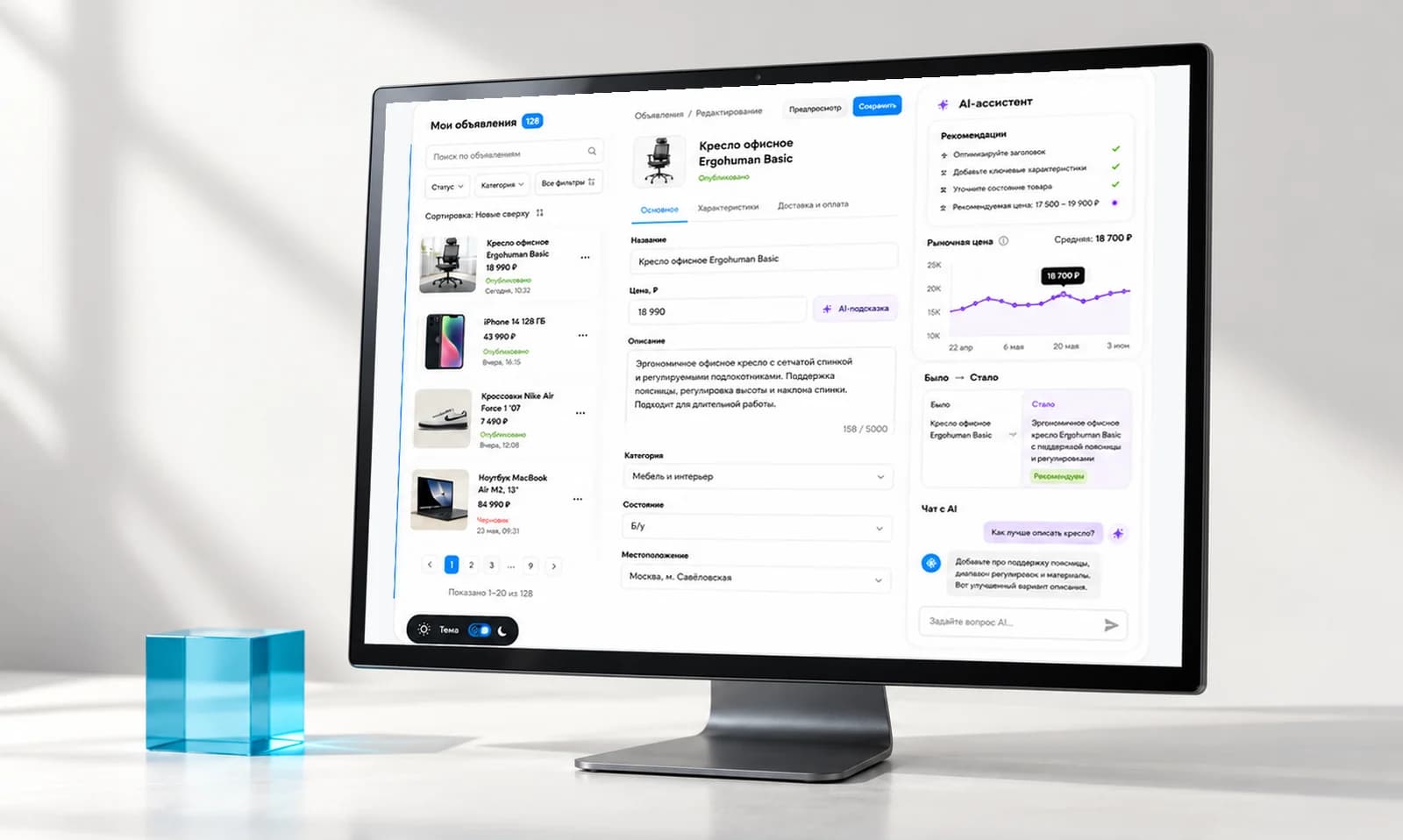
AI Assistant for Listing Optimization
A tool for Avito sellers that helps create and improve product listings faster.
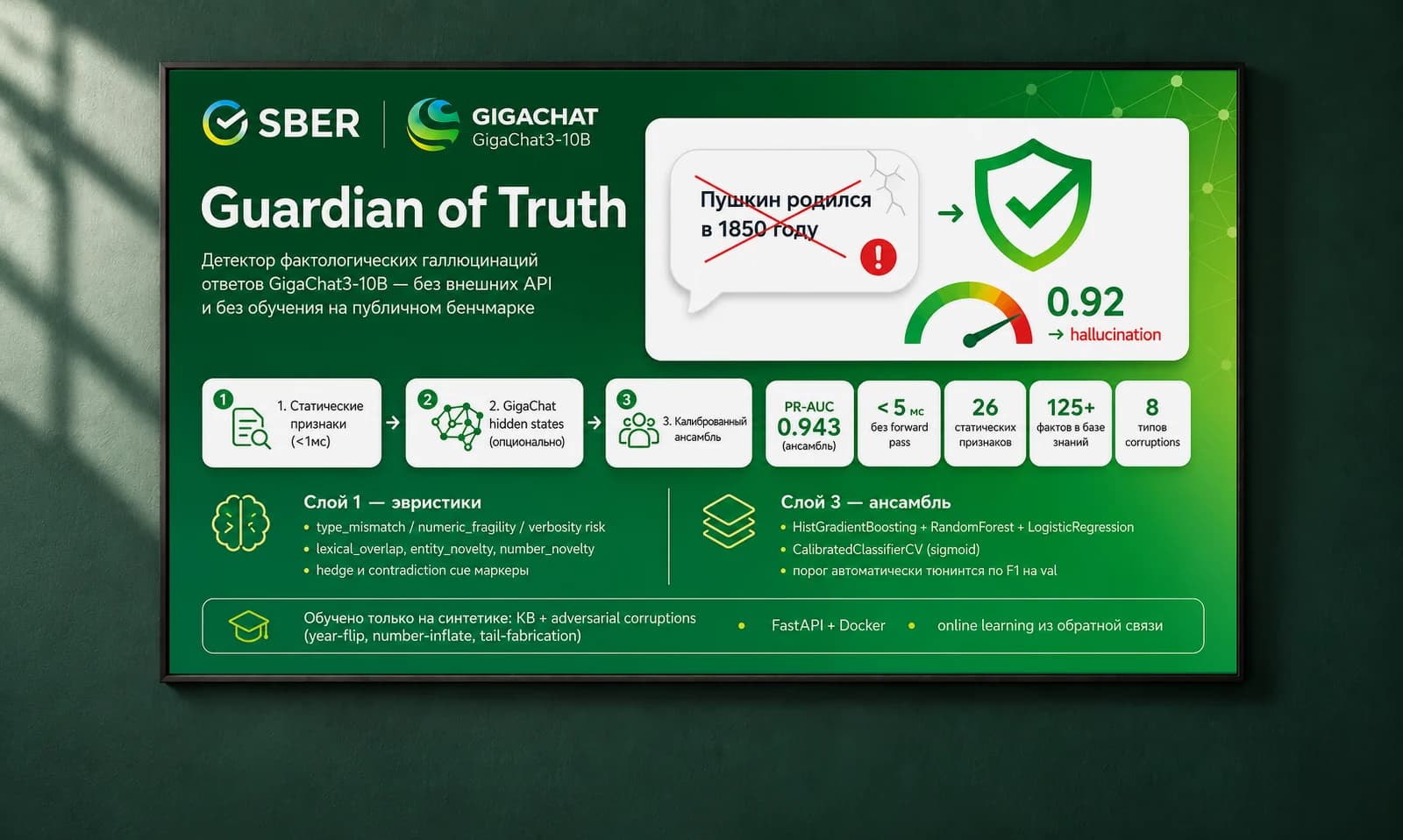
Sber — Guardian of Truth
Checks GigaChat answers for factual hallucinations and returns a probability of invented facts — no external APIs or fine-tuning.

MOEX Alpha Autopilot
An autonomous MOEX trading system: analyses the market, validates ideas and places trades on the live exchange with strict risk controls.
Frequently asked questions
How much does AI implementation cost?
From about $2,400 for a solution built around a specific task: prototype, model or LLM pipeline, API and integration. The cost depends on whether you have labelled data, whether a model needs training or an off-the-shelf one will do, and how deeply the solution embeds into existing systems. Running costs are estimated separately: with external models, monthly request spend can exceed the build cost, so we size it upfront.
We have no data. Can anything be done?
Sometimes. For text and image tasks, off-the-shelf models often work without training on your data, for example extracting fields from documents or classifying inbound requests. For forecasting and recommendations the data is non-negotiable, and collecting and labelling it becomes the first stage. We will tell you plainly if a task is not solvable yet, which is cheaper than a paid experiment with a predictable ending.
Will our data leave for external services?
It depends on the architecture, and that is your decision before work starts. Two routes: external model APIs, cheaper and faster but your data leaves your perimeter; or models deployed on your own infrastructure, more expensive to run but the data stays inside. For sensitive information — personal data, trade secrets, healthcare — the second route is usually the right one, and we design for it from the start.
How is an AI assistant different from a normal chatbot?
A normal bot follows a scripted flow: buttons, branches, fixed answers. It is predictable and it breaks on anything outside the script. An AI assistant answers free-form questions grounded in your documents and knowledge base, including questions nobody anticipated. The trade is quality control: you have to measure correctness and decide where a human stays in the loop.
How do we know AI will pay off?
Count from what the process costs today. If people spend tens of hours a month on repetitive handling — triaging requests, filling in records, digging through documents — the saving is easy to put in money and compare against build and running costs. If no such measurable process exists, start with an audit rather than a model: the task may well be solvable with plain automation and no machine learning at all.
Want to talk it through?
Tell us what needs building. We will work through the task, propose an approach and send a staged estimate. No charge, no commitment.
Related services
- Web app and Telegram Mini App developmentFor when a site is no longer enough and you need a product: an account area, a dashboard, an internal tool or a Mini App inside Telegram. We design the architecture, write the backend and frontend, and take it to release.
- IT consulting and product auditThe most expensive mistakes in software happen before the first line of code: a misread problem, a stack chosen out of a contractor’s habit, and a specification that does not exist. Consulting exists to settle all of that before the development meter starts running: what to build, out of what, at what cost and in which order. The result is a document, not an opinion on a call.
- AI strategy consultingMost companies have already run at least one AI pilot. A minority have taken even one pilot to stable, ongoing use. The gap usually is not the model, it is whether the process had a measurable payoff and whether the real running cost was worked out before starting. We help pick the right entry point so budget does not disappear into a demo that stays a demo.
- Mobile app developmentiOS and Android apps from prototype to App Store and Google Play release. We help you choose between cross-platform and native based on the task rather than on fashion.
Terms used on this page
- Russian personal data law (152-FZ)152-FZ is the Russian personal data law: it requires that data on Russian citizens be collected in databases located in Russia, that the regulator be notified of processing, that consent be obtained separately, and that any breach be reported within 24 hours.
- Prompt engineeringPrompt engineering is the design of instructions for a language model: role, context, task, output format and constraints are written so the result is reproducible, and quality is judged against a set of test cases rather than by impression.
- EmbeddingsEmbeddings are numeric vectors a model produces from text, images or products so that items close in meaning end up close in the vector space, which is what makes semantic search, recommendations and duplicate detection possible.
- AI agentAn AI agent is a program in which a language model does not merely answer but acts: it receives a goal, chooses its own tools such as search, APIs, a database or sending mail, works through steps in a loop and stops when the task is done or a limit is hit.
- LLMAn LLM is a large language model: a neural network trained on vast amounts of text to predict the next token, which is why it can write, summarise and answer, yet it stores no facts the way a database does and can be confidently wrong.
- RAGRAG is a pattern where a language model first retrieves relevant fragments from your own knowledge base and answers from them, which delivers current data and a source citation without any fine-tuning of the model itself.
Further reading
- Where AI and ML Actually Pay Off in a Business, and Where They Are Expensive HypeMachine learning pays off where there is a repeated decision, a lot of similar data and tolerance for error. Missing any one of the three means do not. Here are the use cases that work, their realistic accuracy, the running costs and how to run a four to six week pilot.
- An AI Assistant on Your Own Knowledge Base: How RAG Works and What It CostsHow a RAG assistant differs from a button-tree bot and from an LLM with no data, where hallucinations come from and what actually reduces them, what SaaS costs against a custom build, and which month the project breaks even.
- MVP in 2026: Real Timelines, Real Budgets and What to CutMVP no longer means cheap and rough. A weak prototype today produces a false negative and buries a workable idea. Here are four MVP tiers with prices and timelines, a framework for cutting scope, and the parts no budget justifies removing.