
Development
Landing page development
One page, one goal: the enquiry. We build the landing around a specific offer and the traffic you plan to send at it, whether that is search ads, paid social, organic or email.
- Pricing
- From $200 · ≈ 15,000 ₽
- Timeline
- Around 4 days from an approved prototype and ready content. With heavier design or animation, 7-10 days.
A starting price. The total depends on scope, integrations and deadlines.
In short
A turnkey landing page starts at about $700 and takes roughly 4 days. That covers prototype, design, responsive build, a lead form with notifications, analytics, basic SEO markup and publication on your domain. We build on a CMS (Tilda, WordPress, Bitrix) or on Next.js when speed and custom logic matter.
A structure that gets to the enquiry
A landing page is not a set of pretty blocks, it is a sequence of answers to objections. The first screen says what you offer and to whom. Then proof, offer detail, price or a price range, risk reduction, and one obvious action. The form is repeated down the page so nobody has to hunt for it once they have decided.
- Hero: the offer, the benefit and a button without scrolling
- Trust blocks: work, process, who does it, guarantees
- Price or price range. Hiding price costs you conversions
- An FAQ that clears standard objections before the form
- Forms and messengers, so people can enquire where they prefer
Speed and mobile
Most landing page traffic is mobile, and that is where enquiries leak away: heavy images, layout that jumps, buttons too small to hit. We build with Core Web Vitals in mind — WebP and AVIF images, reserved media dimensions, deferred loading for heavy blocks — and test on real devices, not just an emulator.
Ready for paid traffic
If paid traffic is coming, the page has to measure it. We connect Yandex.Metrica with goals and session recording, Google Analytics, and where needed offline conversions and lead handoff to your CRM. For different campaigns we can ship hero variants so you can see which offer actually performs.
What the work includes
- A structure prototype and an agreed offer
- Design for the hero and every block, desktop and mobile
- Responsive build, verified on real devices
- Lead form with validation, notifications and spam protection
- Admin panel or CMS so content edits do not need a developer
- Yandex.Metrica and Google Analytics with goals configured
- SEO markup: title, description, Open Graph, Schema.org
- Publication on your domain with HTTPS
How we work
- 01
Brief and offer
We settle the audience, the core offer and the target action. Without that, design is guesswork.
- 02
Prototype
Block structure and draft copy, agreed before anything is drawn.
- 03
Design
Desktop and mobile layouts, button and form states.
- 04
Build and wiring
Markup, forms, notifications, analytics, CMS or admin.
- 05
Launch
Device checks, performance, test submissions, then the live domain.
Technology and tools
- Next.js
- React
- TypeScript
- Tailwind CSS
- GSAP
- Tilda
- WordPress
- Bitrix
Selected work

FEIARY Craft
Design for a leather accessories store. The style echoes street and tattoo art to tie the products to a bold youth aesthetic, while the palette signals premium quality. Built by Veltos.Tech together with Makar.
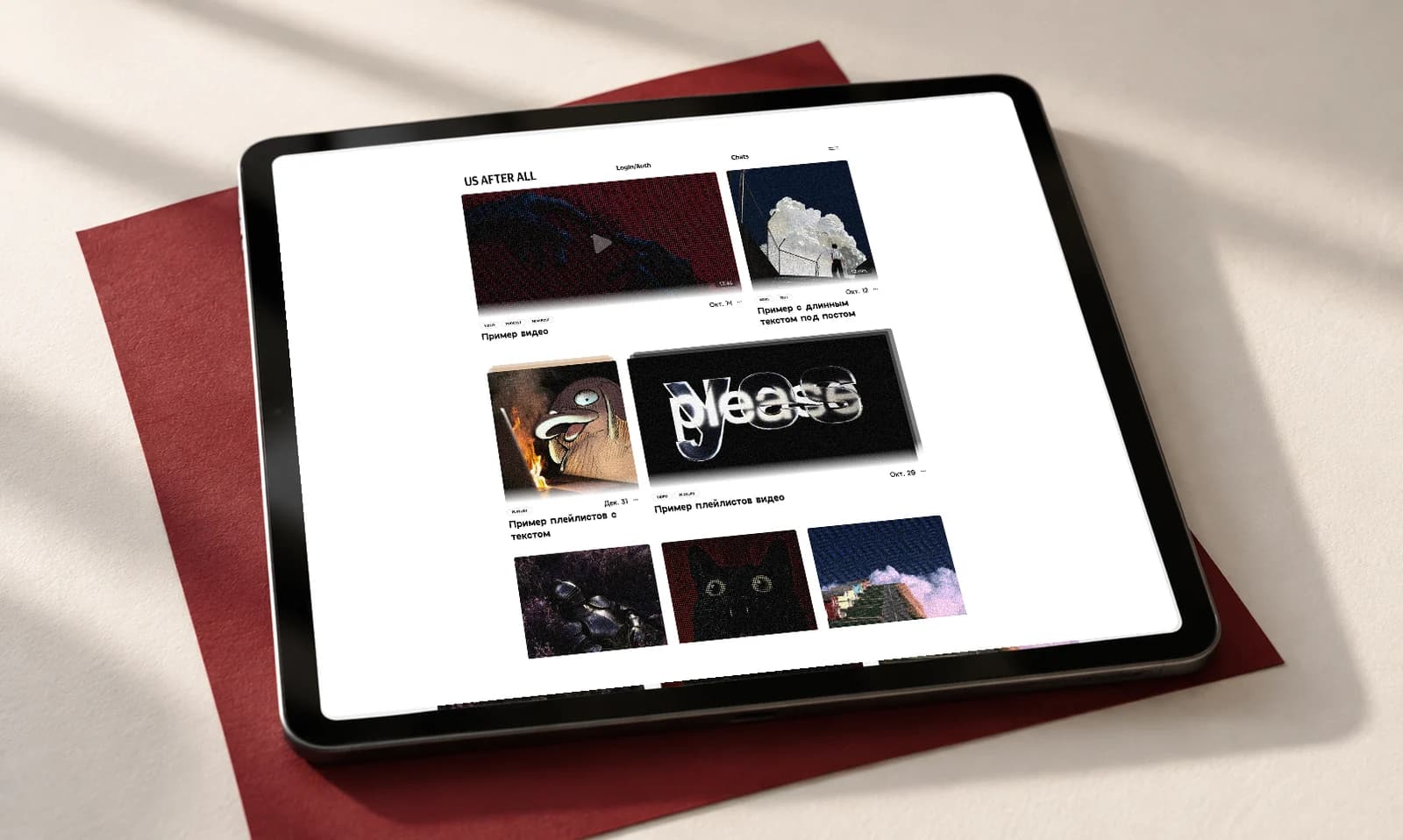
Us After All
A website for the Us After All news agency — a simple, minimalist daily news hub with articles, video, audiobooks and full playlists in one place.

Cyber Lady
Posters for the Colizeum network of esports clubs and arenas. A dedicated banner with promotions for International Women’s Day — warm yellow and pink tones evoke femininity and a welcoming feel inside the club.
Frequently asked questions
How much does a turnkey landing page cost?
From about $700 for a CMS build with design, responsive layout, a lead form and an admin panel. A Next.js landing with custom animation, a calculator or integrations costs more and is scoped by volume. Analytics, SEO markup and publication are included rather than sold as extras. Only the domain, hosting and any photography or stock licensing are billed separately.
How fast can a landing page go live?
Around 4 days when content is ready: copy, logo, photography, a clear description of the offer. With no content, add a few days to prepare it, since that is usually the bottleneck. A 1-2 day rush launch is possible on a CMS if the structure is simple and edits are approved same-day.
Tilda or custom code for a landing page?
Tilda and similar builders are good for testing a hypothesis fast and editing it yourself. Limits show up when you need load speed, complex animation, calculators, A/B tests or deep integrations. Next.js gives full control over performance and logic but needs a developer for edits. For a one-off campaign, take the CMS; for a page that will run a long time on expensive traffic, custom code pays for itself.
Do you write the copy?
Yes. We draft the structure and block copy at the prototype stage, because you cannot design page logic without it. Deeper niche copywriting, with product immersion and customer interviews, is quoted separately. Product facts, prices and legal wording come from you, since those are not things we invent.
Can a landing page grow into a full site?
Yes, and it happens often. If the landing is on Next.js, adding sections, a blog and a catalogue is an extension of the same project and the design and components carry over. On a CMS it is harder: growth sometimes hits the platform ceiling and rebuilding is cheaper. That is why the brief asks about your plans for the next year, not just the task in front of you.
Want to talk it through?
Tell us what needs building. We will work through the task, propose an approach and send a staged estimate. No charge, no commitment.
Related services
- Website development, end to endWe build sites that still hold up a year later: from a one-page CMS build to a store or a web application on React and Next.js. One team for design, code, integrations and launch.
- UX/UI design for websites and appsWe design interfaces that survive contact with production: research, structure, UI kit and a clean handoff to the developers. Everything lives in Figma as components with real states and real breakpoints, not as a folder of flat mockups. The same process covers landing pages, corporate sites, e-commerce, web apps and mobile.
- Targeted and search advertisingPaid advertising brings traffic the day after launch, and burns budget just as fast when audiences are guessed at and nobody counts the leads. We build campaigns in the channels that genuinely work in Russia in 2026: VK Ads, Telegram Ads and Yandex Direct, plus Meta and Google Ads for projects selling abroad. Tracking goes in before launch, not after.
- SEO and GEO website promotionSearch traffic is the one acquisition channel that keeps working after the ad budget stops. We run two tracks in parallel: classic SEO for Yandex and Google, and GEO, the work of getting your pages quoted inside AI Overviews, Yandex Neuro, ChatGPT and Perplexity, where a growing share of queries now ends. It starts with an audit, never with buying links.
Terms used on this page
Further reading
- What to Build Your Site On in 2026: Tilda, WordPress, Bitrix or Next.jsBuilder, CMS or custom code is not a matter of taste but of scenario and planning horizon. We break down three-year cost of ownership, the ceiling of each platform, and what it costs to move if you picked wrong.
- What a Website Actually Costs in 2026: The Estimate, Line by LineA practical breakdown of a web development estimate: what analytics, design, front end, back end and integrations actually cost, which expenses always show up after launch, and where cutting the budget is safe.
- A Slow Site Loses Money: Core Web Vitals and ConversionSite speed is not a technical metric, it is a line in the revenue report. Core Web Vitals explained in plain language, how to find the real cause of a slow page, and a fix list sorted by return per hour of work.