
Promotion
SEO and GEO website promotion
Search traffic is the one acquisition channel that keeps working after the ad budget stops. We run two tracks in parallel: classic SEO for Yandex and Google, and GEO, the work of getting your pages quoted inside AI Overviews, Yandex Neuro, ChatGPT and Perplexity, where a growing share of queries now ends. It starts with an audit, never with buying links.
- Pricing
- From $160 · ≈ 12,000 ₽
- Timeline
- Audit and keyword research take two weeks. The first technical fixes ship in weeks 3 to 4 and the first content in weeks 4 to 6. Long-tail movement becomes visible after 2 to 3 months, commercial terms after 4 to 6. Six months is the minimum sensible engagement: one or two months is enough to fix the technical base but not to earn traffic.
A starting price. The total depends on scope, integrations and deadlines.
In short
SEO and GEO promotion starts at ₽40,000 per month. Month one covers keyword research (typically 300 to 1,500 queries), technical fixes, site structure and metadata. From month two we add content and external signals. Long-tail queries usually start moving in 6 to 10 weeks, while competitive commercial terms take 4 to 6 months. In parallel we format pages so AI engines can quote them.
What SEO work actually covers
SEO breaks into five blocks: keywords, technical health, site structure, content and external signals. The weakest block caps everything else. Perfect copy will not rank a site that takes eight seconds to load, and a fast site with no commercial pages has nothing to show for a buying query.
We open with a one to two week audit: build the keyword set, cluster it by intent, map clusters onto the current structure and find the gaps, both queries with no page behind them and pages cannibalising each other for the same query. That becomes a six month roadmap prioritised by impact against effort.
- Keyword research and clustering: from 300 queries for a service site to 20,000 plus for an online store.
- Structure: one landing page per commercial cluster instead of a single catch-all services section.
- On-page: title, description, H1 to H3, alt text, readable URLs, internal links and breadcrumbs.
- Content that answers the query rather than padding word count with keywords.
- External signals: directories, maps, industry platforms, publications and brand mentions.
GEO: getting quoted inside AI answers
GEO (generative engine optimization) differs from SEO in what actually competes. In SEO, pages compete for a position. In GEO, passages compete for a citation. A generative system splits your document into passages, scores each against the question and assembles an answer from several sources. So each paragraph has to stand on its own, carry facts and be easy to verify.
In practice: a direct answer in the first two or three sentences of a block, details after that; concrete numbers, timelines and prices instead of vague promises; unambiguous entities (who you are, where you operate, what you do, what you are connected to); Schema.org markup that repeats the same meaning in machine-readable form; and an FAQ block phrased the way people actually ask.
On llms.txt: the file is cheap so we ship it, but Google has publicly stated it does not use llms.txt in Search, and no major engine has announced official support. It cannot carry a strategy. What genuinely drives citations is different: content that renders without JavaScript, fast server response, a clean heading hierarchy, structured data and brand mentions on third-party sources.
- Answer-first blocks: every section opens with a direct 40 to 70 word answer.
- Schema.org in JSON-LD: Organization, Service, FAQPage, BreadcrumbList, Article.
- AI crawler access: GPTBot, PerplexityBot, ClaudeBot and Yandex handled as a deliberate robots.txt decision, not an accident.
- Tracking: we regularly check who gets cited for your key questions and what the competitors have that you do not.
Yandex and Google play by different rules
In Russia the larger share of commercial search sits with Yandex, especially on mobile and in combination with Maps, Business listings and Direct. So Yandex usually takes priority while Google follows from the shared foundation. Both webmaster consoles still need setup and monitoring, because indexation between them diverges.
Yandex reacts strongly to user behaviour and commercial signals: visible prices, delivery terms, company details, contacts, reviews, catalogue depth and how complete each product page is. Google leans on link profile, author expertise and Core Web Vitals. The same site can hold a top-3 spot in Yandex and sit on page two of Google purely for lack of external mentions.
- Yandex: Webmaster, site quality index, regional targeting, Yandex Business, map reviews, commercial factors.
- Google: Search Console, link profile, E-E-A-T, Core Web Vitals, clear authorship.
- Shared: speed, mobile rendering, unique content, no duplicates and correct indexation.
The technical foundation everything rests on
The technical audit clears whatever stops a crawler from reaching your content: duplicate pages, wrong canonicals, sections blocked in robots.txt, broken redirect chains, missing or stale sitemaps, soft 404s returning a 200, infinite catalogue filter URLs, oversized images and content that only appears after JavaScript runs.
Rendering gets separate attention: if the content only arrives via script, some crawlers, AI bots in particular, will never see it. For Next.js and similar frameworks the fix is server rendering on key pages. We hand your developers precise tickets, and if there are no developers we make the changes ourselves.
- Core Web Vitals: LCP, CLS and INP measured on field data, not just lab runs.
- Indexation: reconciling sitemaps against Webmaster and Search Console reports to find orphaned pages.
- Duplicates and cannibalisation: consolidation, canonicals and rules for parameters and filters.
- HTTPS, mirrors, clean URLs, hreflang for bilingual sites and a proper 404.
Reporting: what we count as a result
Positions are an intermediate metric. The one that counts is non-brand organic traffic and the enquiries it produces. That is why the report separates brand queries (your company name) from non-brand ones. Traffic growth driven by a brand campaign has nothing to do with SEO, and presenting it as a result would be dishonest.
The monthly report runs four to six pages: position movement by cluster, organic traffic and conversions from Metrica and GA4, status of technical tickets, what was published, which external placements appeared and where AI search is citing you. A separate block sets out next month with the reasoning behind each priority.
What the work includes
- Clustered keyword set mapped by intent onto specific pages
- Technical audit: a prioritised ticket list with acceptance criteria for each fix
- Rewritten metadata, headings, URLs and internal linking
- Schema.org JSON-LD markup: Organization, Service, FAQPage, BreadcrumbList
- A content plan plus two to four articles or landing pages a month
- Yandex Webmaster, Search Console, Metrica and GA4 configured with goals and reports
- External placement plan: directories, maps, industry platforms and PR mentions
- Monthly report on positions, non-brand traffic and AI answer citations
- A short guide for your team on publishing new pages without breaking SEO
How we work
- 01
Audit and keyword research
Weeks 1 to 2. We build the keyword set, cluster it, capture baseline positions, run the technical audit and break down three to five competitors from the top of the results. The output is a six month plan with priorities.
- 02
Technical fixes
Weeks 3 to 5. We close out indexation, duplicates, speed, rendering and markup. Some tickets go to your developers, and we implement the rest ourselves where we have access.
- 03
Structure and content
From month 2. We create the missing landing pages for commercial clusters, rewrite weak copy and add FAQ and answer-first blocks for GEO.
- 04
External signals
From month 3. Directory and map listings, industry platforms, publications and brand mentions on the sources AI systems draw context from. No link networks or automated blasts.
- 05
Iteration and reporting
Every month. We look at which clusters grew, which stalled, and reallocate effort accordingly. The report and next month plan arrive by the fifth.
Technology and tools
- Яндекс.Вебмастер
- Google Search Console
- Яндекс.Метрика
- GA4
- Screaming Frog
- Key Collector
- Ahrefs
- Topvisor
- Schema.org JSON-LD
- PageSpeed Insights
Selected work
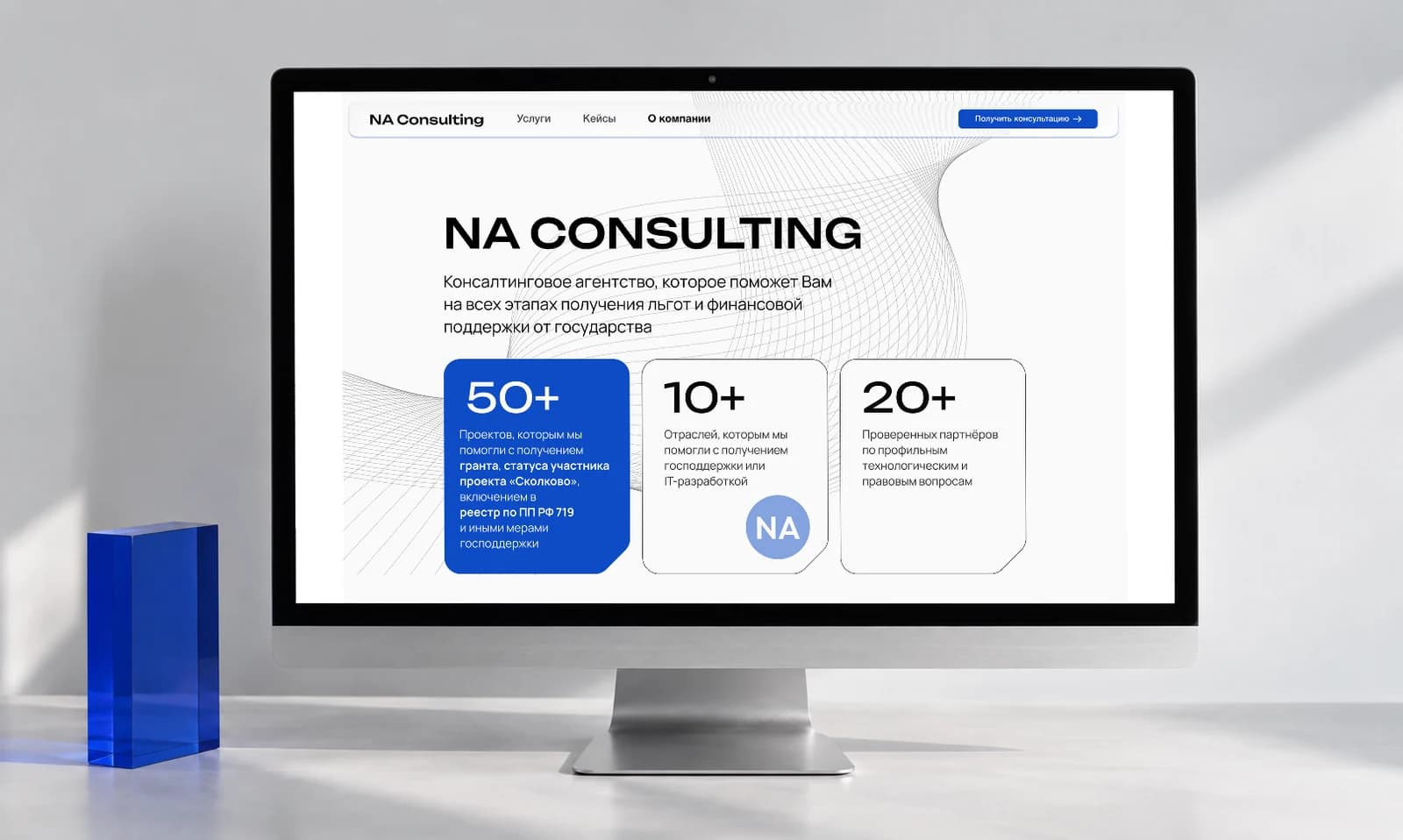
NA Consulting
A website for the NA Consulting agency. An interactive landing page packs the full story of the agency and its services into a minimalist layout. Calm colours convey trust and professionalism. Built by Veltos.Tech together with Aliya (finnikkis.github.io/maulaviyevadesign).

Us After All
A website for the Us After All news agency — a simple, minimalist daily news hub with articles, video, audiobooks and full playlists in one place.

FEIARY Craft
Design for a leather accessories store. The style echoes street and tattoo art to tie the products to a bold youth aesthetic, while the palette signals premium quality. Built by Veltos.Tech together with Makar.
Frequently asked questions
How much does SEO cost per month?
Ongoing SEO starts at ₽40,000 a month, which fits a service site or a small catalogue: keyword maintenance, technical support, two to four content pieces and on-site edits. An online store with thousands of product pages, or a competitive niche such as real estate, legal or medical services, usually needs ₽80,000 to ₽150,000 a month. A standalone audit with no retainer starts at ₽30,000. Placement budgets are quoted separately and stay under your control.
How long before SEO shows results?
Long-tail and informational queries usually move 6 to 10 weeks after the technical fixes and first content ship. Mid-competition commercial terms reach the top 10 in about 4 to 6 months, and head terms take 8 to 12. Domain age matters: a site younger than six months almost always ranks slower in Yandex. Anyone promising top positions within a month is either manipulating behavioural signals or reporting on queries you already ranked for.
What is GEO and how is it different from SEO?
GEO stands for generative engine optimization: getting your content used inside AI answers such as Google AI Overviews, Yandex Neuro and Alice, ChatGPT and Perplexity. The unit of ranking changes. SEO competes for a page position, GEO competes for a passage to be quoted. In practice that means a direct answer in the first two or three sentences of a block, facts with numbers and dates, Schema.org markup, unambiguous entity signals and brand mentions on sources the models already read.
Do we need an llms.txt file?
It is cheap to add and worth very little on its own. Google has publicly said it does not use llms.txt in Search, and no major search engine has announced official support. Some AI crawlers do read it, so we ship it as a low-cost hedge, never as a strategy. What actually earns citations is different: content that renders without JavaScript, fast pages, a clean heading structure, structured data and passages that answer the question directly.
Do you optimise for Yandex or for Google?
Both, with Yandex usually taking priority because it holds the larger share of commercial search in Russia, especially on mobile and alongside Maps and Direct. The foundation is shared: keywords, structure, content and speed. After that the systems diverge. Yandex reacts to user behaviour and commercial signals such as prices, delivery terms, contacts and company details, while Google leans on links, expertise and Core Web Vitals. We run both webmaster consoles and split the backlog accordingly.
Do you buy backlinks?
Only where it is safe and makes sense: industry directories, Yandex Business and map listings, articles in trade media, mentions in roundups and ratings. We do not touch private blog networks, automated link blasts or marketplaces selling a thousand links for pocket change, because that is the fastest route to a penalty. For a young site the first three or four months are better spent on content and technical health, since links convert to rankings only once those exist.
Want to talk it through?
Tell us what needs building. We will work through the task, propose an approach and send a staged estimate. No charge, no commitment.
Related services
- Targeted and search advertisingPaid advertising brings traffic the day after launch, and burns budget just as fast when audiences are guessed at and nobody counts the leads. We build campaigns in the channels that genuinely work in Russia in 2026: VK Ads, Telegram Ads and Yandex Direct, plus Meta and Google Ads for projects selling abroad. Tracking goes in before launch, not after.
- SMM and social media managementSocial media stopped being a place where posting regularly is enough. In Russia two platforms are left standing, Telegram and VK, and each distributes content by its own rules: Telegram has no algorithmic feed and almost no organic growth, while VK hands out reach through short video and recommendations. We build the work around that reality: strategy, content pillars, a steady production rhythm and metrics that mean something.
- Website development, end to endWe build sites that still hold up a year later: from a one-page CMS build to a store or a web application on React and Next.js. One team for design, code, integrations and launch.
- Landing page developmentOne page, one goal: the enquiry. We build the landing around a specific offer and the traffic you plan to send at it, whether that is search ads, paid social, organic or email.
Terms used on this page
- Commercial ranking factorsCommercial ranking factors are the group of signals Yandex applies to commercial queries: visible prices, assortment breadth, contact and company details, delivery and payment terms, reviews and live chat, in other words evidence that buying here is actually possible.
- Schema markupSchema markup is structured data based on the Schema.org vocabulary, usually delivered as JSON-LD: it tells search engines and AI answer engines which part of the page is a product, a price, a review, an organisation or a question with its answer.
- Behavioural signalsBehavioural signals describe how users act in the results page and on the site: whether they click the snippet, whether they bounce back to search afterwards, how long they stay; Yandex uses them in ranking and penalises manipulation aggressively.
- Semantic coreA semantic core is an intent-grouped list of the search queries a site should be found for: collected from Wordstat, Webmaster and competitor tools, then clustered by results-page overlap so you know how many pages are needed and what each one covers.
- End-to-end analyticsEnd-to-end analytics is the system that links an ad click to booked revenue: data from ad accounts, call tracking, the website and the CRM is stitched together by visitor identifier so payback can be calculated per channel, campaign and keyword.
- AEOAEO is optimising for direct answers: a page is built so a search engine or voice assistant can extract a ready response to a specific question, whether that is a short paragraph under a heading, a list of steps, a table or a marked-up FAQ block.
Further reading
- SEO in Yandex in 2026: what changed and what no longer worksLink buying is dead weight, templated copy pushes pages into the low-value bucket, and behaviour manipulation is no longer a grey tactic but a way to lose the site. Here is what actually drives Yandex rankings in 2026.
- GEO in 2026: how to get cited by ChatGPT, Alice and AI OverviewsGEO is not a separate channel, it is a layer on top of SEO. Here is how six answer engines pick sources, what makes a page quotable, the honest truth about llms.txt, and a weekly method for measuring AI visibility.
- Yandex and Google: how promotion differs and how to work with bothOne site, two search engines, two different ranking logics. Where the differences actually change the work, why regional settings matter so much in Yandex, and how to build a strategy without writing everything twice.